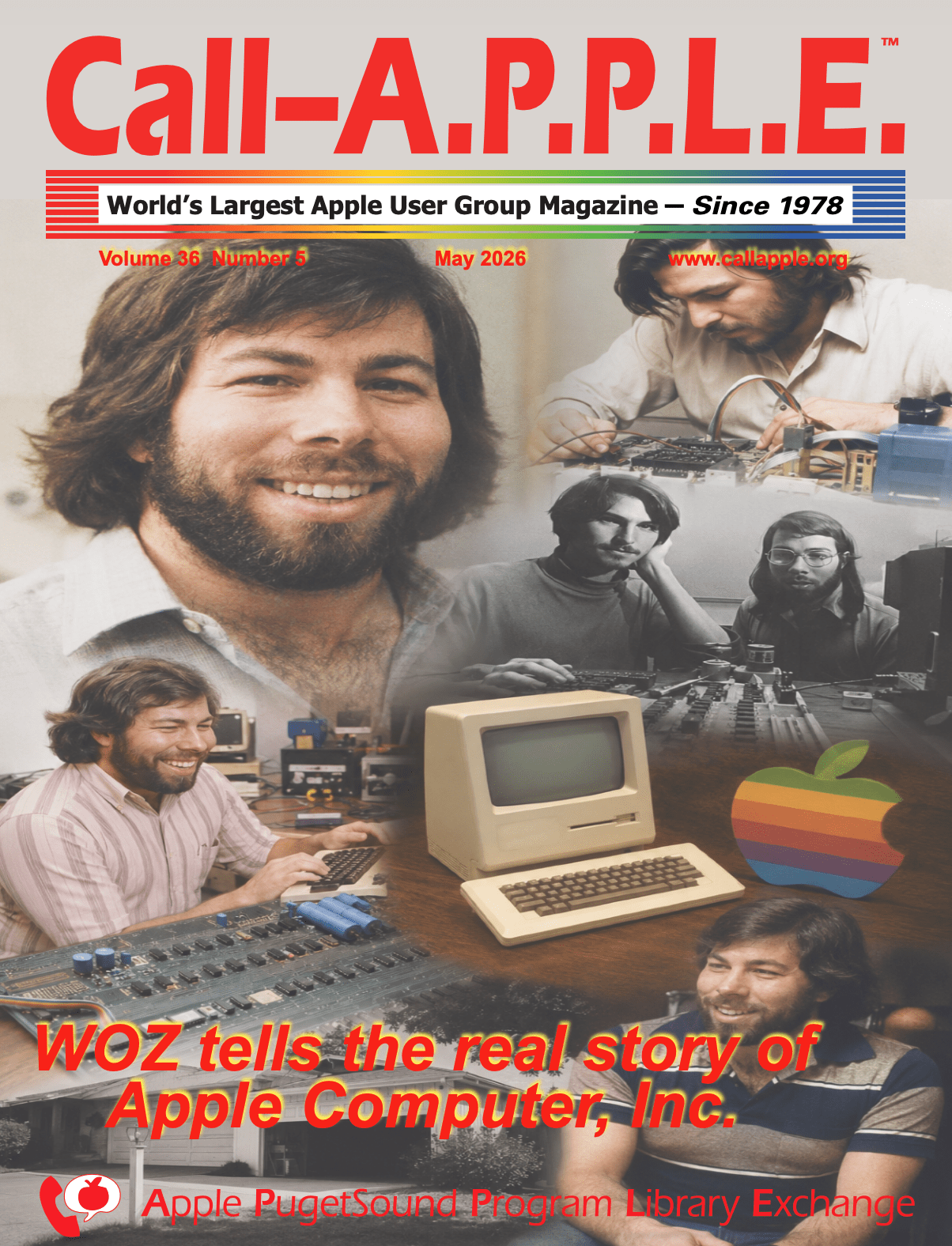
Back Issues

Reflections: The Return of Call-A.P.P.L.E.

In 1981, I worked with a group of people who had begun a journey of amazing proportions. This particular group had managed to provide much of the information about the Apple computer available at the time. This information came in many forms. Software. Documentation. Even Hardware. It was only available through Apple PugetSound Program Library Exchange or A.P.P.L.E. for short.

The brainchild of Val J. Golding, the group started in December 1977 as an idea due to the fact that Apple Computer released the Apple II and several people in the area including Val had purchased this new more refined computer from Apple Computer Inc. Through introductions to Bob Huelsdonk and other Apple computer users in the local are and at the behest of Max Cook, manager of Computerland, Val scheduled a users group meeting.

The first meeting took place in February 1978 and began what would become a 12-year odyssey producing one of the finest and most informative magazines in the Apple world. While the ride was fun and always interesting, it wasn’t always without problems. The first problem came in 1984 when Val Golding left the company to work on another Apple magazine. This change brought about a bit of a shock for the magazine for which Val’s golden pen had always been a welcome sight.

The next problem that arose was the state of Washington coming down on the group over its status as a non-profit organization. This proved to be a major change that brought about the group’s first change in name. This type of problem continued and in 1988, the group changed names again.

In 1989, the group had run its course due to many problems in production and management, the magazine changed to a quarterly. Although this change was in retrospect a good idea, it also brought about the halting in production with only one issue following in 1990. The end came swiftly for what was supposed to end this glorious journey.

But that is only part of the story…

And now, the rest of the story…

Although many interesting times have come and gone in the life of this programming editor, I have always found that the best things were those that came the hardest. One of the hardest things I started was a project to preserve the materials from the early years of the Magazine. It was during this time that I contacted the founder of A.P.P.L.E., Val Golding. He, as always, had a lighthearted approach to the way the world was and had words of encouragement. Thus I pursued the preservation project with even more fervor. In contacting people who I worked with and who were of major importance, one of these people had an idea that everyone snickered at when it was first heard.

The idea was to restart the magazine. The person who recommended it was former A.P.P.L.E. writer Rick Sutcliffe, author of The Northern Spy. In listening to what Rick had to say, the words somehow struck a chord with me and I thought, “This is an idea whose time had come!”. From that point on I pursued the mission with the utmost care contacting everyone from Val in Seattle on down to Don Williams in Mexico. As I talked with each of the former board members, the first reaction was one of a chuckle and then serious talk.

Fortunately the voices were for the most part encouraging and as I continued pursuing the support of the core group, the look of the reborn magazine was beginning to take shape. Thus as Val has said in the past, “We have come full circle”.  When I finally discovered that things had been kept alive by Norman Dodge, the BBS System operator for A.P.P.L.E. / Tech Alliance, I discovered even a bigger treasure trove of materials than we had figured existed.   I flew to Seattle and received all of the materials from Norman.  He had managed to keep the club alive from 1994 to 2001 and Dick Hubert from 1990 to 1994. Dick ran what was left of the original group, producing the Co-Op Spirit Newsletters which you find here on the website. Norman then took over things along with Bill Bredehoft and a host of other Apple and Mac enthusiasts, continuing until 2001. Their efforts were the ones that we have to thank for all of the materials and customer lists still being intact within the group.

And thus from the ashes from the original group and the original magazines has come the phoenix. The re-birth. The here and the now. And without further delay, we here at Apple PugetSound Program Library Exchange (A.P.P.L.E.) present Volume 14, Number 1

A.P.P.L.E. Glimpses

A.P.P.L.E. Glimpses is a product introduction article. Each month, we will be introducing items which we think are noteworthy here. Although items are listed here, it does not mean an endorsement. It only means that we figured the item was interesting enough to be noted to the Apple community.

This month we have a nice variety of items. We hope that you will find them as interesting as we did. If you do decide to purchase a product we mention here, mention that you saw it in Call-A.P.P.L.E. Magazine.

Netscape 6.2 now available!

Netscape released the latest version of the its Internet browser this week. Their latest attempt to catch back up with Microsoft’s Internet Explorer is a solid piece of work. Whether or not this attempt will be enough to bring them back up to where they once were will depend a lot upon how many holes are discovered in the software in the coming weeks and months and how much effort Microsoft puts into bringing their own browser into the foreground.

The war between the two browsing companies has been back in the legal arena in recent weeks with Netscape’s parent company AOL-Time Warner bringing a lawsuit against Microsoft. But up until this release, it was not readily apparent that they would also bring out a new version of software to boost their attempts to gain market share.

Although this release is not much more than a minor update, it does bring about closure to some of the problems that were in version 6.1. It also finally has complete support for the new version of OS X.

You can read more about this at the Netscape home page at http://home.netscape.com/browsers/6/index.html

Netscape World Headquarters P.O. Box 7050
Mountain View, Ca. 94039-7050 Tel: (650) 254-1900 Fax: (650) 528-4124


Xante Introduces 1200 DPI Printer

Xante Corporation introduced a new 1200 DPI Printer for OS X which is both high speed and extremely clear for a monochrome printer. The printer which includes compatibility for Adobe Postscript 3 also has a high speed Risc based controller.

With a claimed 10,000 page toner cartridge life span, this printer will not only be powerful but also economical to run. At a weight of 27 lbs, it is not exactly a lightweight printer but it is definitely a printer that is worth its weight in gold to the small business.

You can read more about this at the Xante web page at http://www.xante.com/products/aw1200/index.html

XANTÉ Corporation 2800 Dauphin Street Suite100 Mobile, AL 36606 Tel: (251) 473-6502 Fax: (251) 473-6503 US & Canada: (800) 926-8839 ussales@xante.com


Seti@home Client Ver.3.07 for Macintosh Now Available

The latest version of the popular combination screen saver / data analyzer from Seti@home is now available for download from the project web site. The screen saver downloads data chunks in 350K blocks from the website and analyzes them when the screen saver is active or in the background depending on the user controlled settings.

The SETI @ Home project that was started in 1996 with a scientific study now boosts more than three million members of which over 500,000 are currently actively analyzing the data chunks. The project uses data garnered from the SETI projects radio antennas and allows users to have their computers analyzing the data while at the same time preventing screen burn in. The unique screen saver project is now the world’s largest private computing project.

You too can join the project if you have not already signed up by going to the website listed in the information below. Many companies and groups have members who form up competing groups to see who can analyze the most data.

The project has accumulated over half a million years of analyzed data and this is constantly being added to on a daily basis. The project is also gearing up for the second round of analyzing information in order to eliminate noise and false signals.

Although the project uses a graphical program as its primary system, the program is also available for other OS’es with text based analyzers. Also certificates of completion are available from the web site once major milestones have been achieved with the first one being 100 blocks of data.

A.P.P.L.E. has donated time on some of its computers to this project and has now passed a total of more than 700 blocks of data analyzed.
The project which is managed by Dr. David P. Anderson resides at U.C. Berkeley and is funded primarily by private and corporate donations.

SETI @ Home

http://setiathome.ssl.berkeley.edu/

The Northern Spy — Nellie and The Pirates

“Hey, sir, look at this!”.

That is one thing that you can rely on about Nellie Hacker. When she has something to say she just bursts right in.

“I thought you were typing up one of my articles tonight.” I shot back to the other end of my lab where Nellie sat hunched over the computer keyboard.

“Oh don’t worry, I keep track of my time. I’m finished, so I thought I would boot up this disk I got from Alex the other day. It looks like a giant accountant’s worksheet with rows and columns that you can put all sorts of formulas into. This is really nifty!”

“Sounds like a spreadsheet to me, Nellie. Where did you buy it and how much did you pay?” I solicited.

“O, Alex just ran me off a copy and photocopied the manual he was using; he didn’t charge me anything.”

I had finished marking the last of the labs by now – a good one too, and wouldn’t you know it was hers – so I decided to return it there and then and to see what she had.

“You’ve got a rip-off of Busy-Calc, Nellie.” I tried to make it sound like bad news.

“What’s that?”

“It’s a well known program of this type. They have sold thousands of copies on protected disks that you are not supposed to be able to duplicate. It retails for about $250.”

“You mean…”

“Yes, Nellie. You’ve got a hot program in your hot little hands; why, I could turn you in – some manufacturers give pretty big rewards.”

“But, how could I know? There’s no copyright notice in the manual.” Nellie was indignant. “Wait until I see that Alex.”

“This one I know because I once bought it myself,” I responded. “Obviously, some enterprising soul has produced this brief manual in an attempt to make money from another person’s program.

“Besides, Alex could never in his lifetime come up with a program like this; and you can bet there’s nothing of this quality in the public domain either.”

“That’s the stuff anybody can copy, right?”

“Right, Nellie.”

“But, who can afford to pay retail for this? I mean, like $250 is pretty ridiculous. If you own a business or something, you pay the shot of course. But, what about us students? It’s one thing to pay, maybe, thirty bucks like we would for a text, but this kind of price is just out of sight!”

“Well Nellie, the manufacturer would say that he needs that high price to justify the cost of production.”

“That’s absolutely ridiculous. A disk costs about two dollars, the manual no more than eight, and even if they pay that much out in overhead and split the same with the author as profit – it still comes to only thirty dollars.”

“Actually, Nellie, advertising is pretty expensive, and they might have to pay the author of the manual – after all, a lot of programmers are illiterate.” She gave me a savage look, so I quickly added; “Not you of course, your writing is as brilliant as always. Here, have your lab back,” I added, hoping that she would be mollified by yet another perfect score.

“Furthermore,” I continued without missing a beat, lest we start a new conversation before this one was half done, “even if it went to a wholesaler for, say, sixty dollars, he might as much as double the price, and the retailer could do the same. Add a few taxes along the way and you’ve got your $250 in jig time.

“I still say the whole thing is absurd. Let’s set aside wholesale and retail rip-off pricing policies for a minute and look at it this way: Suppose as an author you are getting a twenty percent royalty. Now, wouldn’t you rather have a fifth of 20,000 copies times a selling price of $20 than a fifth of 500 copies times a price of $250? After all, if you offer a good product for a sensible price aren’t you going to sell it by the bag full?”

Nellie was not the sort of person who needed to waste much time on mental multiplication, and I could see that she obviously understood the business principles involved better than I had thought, so I replied: “I figure it that way too, girl, and so do a few software houses that are putting prices down from the $200- $300 range to a tenth of that. In fact some of them have ended up backordered by thousands of copies as a result.

“However, it seems that most of the people who have been in the business for a few years have grown up with the fat prices and are sticking to those high markups with the low volumes that they imply.”

“I hope they go broke.” Nellie put in.

“So do I, Nellie, so do I.”

She gave a sort of “harrumph” that sounded suspiciously like one of my own as she dumped the offending “document” into the round file, along with the label from her diskette. The latter quickly went back in her box of blanks. I’m proud to say, that girl does have a well-tuned sense of what’s right.

“By the way, I thought you said that these kinds of diskettes were uncopiable,” Nellie proffered after a few moments. “How did Alex get one that he could copy for me?”

“O Nellie, there is no such thing as a really uncopiable disk. There are all sorts of programs around that are designed for just that. In fact, what with one group of programmers inventing new ways to lock diskettes, and another group working on ones to copy them, a tremendous amount of time and talent has been tied up on this problem alone. You should read the magazine ads more often.”

“Haven’t the time,” she sulked. “You should see the English assignments Mr. M is giving us.”

“And I’ll bet”, she added after the briefest of pauses, putting us abruptly back on the subject, “that they charge plenty for their picklock software and that their programs can’t copy themselves.”

“Of course they can’t,” I responded, answering her points in reverse order, “and they do charge between fifty and a hundred dollars, but people just buy two different kinds of copiers. In fact for that higher price, you can pick from several kinds of hardware devices which work by making a ‘snapshot’ of everything in memory and then putting it on a disk in an unlocked format. For those, you don’t even need any software, it’s all built into the hardware card.”

“That’s disgusting.” Nellie was becoming quite agitated, as she always does when the issue under discussion offends her moral sensibilities. “If they really thought they were providing any kind of legitimate service, they would sell their own stuff for a lot less and on copiable disks at that. They’re no better than all the rest of them – just out to cheat us out of all the money the traffic will bear.”

“Now, hold on a minute, kid. What if you do buy one of those expensive locked disks, because it just happens to be the best program available for your needs (and you also have the money to do it). Do you really want to get stuck without a backup?

“Wouldn’t you rather be able to make your own cheap copies for backup as soon as you buy a program, just in case? Wouldn’t you like the freedom to have several copies of a word processor configured for your different writing needs? Wouldn’t you also like to be able to save some three hour long game on a disk so that you can resume play at a later date?”

“Uck, you know I can’t stand all those gamey things”, she put in. “They are full of nothing but violence and fantasy. Give me concrete applications for computers any day over silly games.

“Besides, is even that sort of copying allowed? I’ve read some of the package notices and they can make it sound like you’re a criminal if you even read the thing from the disk into the memory of the machine.”

“I must have told you a million times, Nellie, don’t exaggerate. But yes, it is allowed. As long as you do not sell or give the copies away, you can make as many as you want for your own use. What the vendors are most worried about is the large scale rip-off artists who run off hundreds of copies and sell them cheap or give them away at their club meetings.

“The worst offenders are schools. A lot of Districts buy a single copy of some major software package and then proceed to run off one for each machine in their jurisdiction. That can run into the thousands in some cases.”

“The trouble is, in their zeal to stop these big thefts, the manufacturers are interfering with the legitimate rights of their honest customers. Why some of them include the most extravagant anti-copying and warranty disclaimer notices I have ever seen on any product. They try to be as intimidating as possible to protect their investment, I suppose.”

“But, it’s like I keep saying, sir. If they are going to ask outrageous prices like $250, nobody is going to buy more than one copy, and precious few are even going to do that.

“They are just making it too tempting to be a crook. And can’t the people who steal software in that way see that that is just what they are – crooks? Not only that, but that they are ruining the market for the people who want to write good programs, especially for the schools – if they are as bad as you say in this respect.”

She continued her scatterrgun condemnation of all involved, both indignant and a little breathless: “Besides, what are they supposed to be teaching us kids about honesty, and trust and all that stuff?.”

“I’m glad to hear that you care too, Nellie, but let’s be realistic: What fraction of the people in our society really do? As you say, the prices are far too high – they do make the temptation too great for most people to handle. Not only that, honesty in such matters is not even an issue with most people. They might not hold up a store; they might even hesitate about shoplifting, but if they can get away with stealing something in the privacy of their homes, they do not even give it a second thought. It takes a higher power than the law of the land to change people, so the problem is not going to be solved just by passing tougher laws. There isn’t a program available today for any micro that can justify even a $100 price tag at retail. “Games should be under twenty dollars, utilities up to thirty, spreadsheets and word processors up to sixty, and systems packages at the upper limit of a hundred.

“All software should be unlocked and you should be able to make as many copies as you want for yourself, with manuals selling for 25% of the package cost on the understanding that an organization can place the program at one location per manual they buy.

“If prices were brought within reason, people would willingly foot the bill for the originals and piracy would not pay. Then the better software availability and lower prices would result in higher sales volumes for both programs and machines, and we would go into a spiral cycle of higher demand coupled with lower costs due to economies of scale. Ultimately the whole industry would benefit – we poor consumers most of all.”

“That would help the individual owner, and schools too, but how would you deal with the clubs and others who just pass the stuff around to their friends for free?” Nellie asked.

“The same way as they do it in the music industry, Nellie–with media royalties.”

“I can see how you could put a royalty on blank disks as they do on cassette tapes and then divvy it up among the programmers, but how do you decide on each person’s fair share? You can’t very well monitor the number of times a program is run,” she added, with a look of puzzlement. “After all, there isn’t any such thing as air time in the computer industry, you know.”

“I wasn’t talking about air time, Nellie. What I had in mind was just collecting the sales figures on the various commercial programs from the software houses. This could be done by a central agency which could then divide up the royalties to authors and publishers on a percentage basis calculated on their share of the total amount. They would go along with it because it would mean more revenue, and the disk manufacturers would too, because in the long run the general volume increases would result in them also selling more of their products.”

“It sounds like a good idea, but do you really think they will take the first step by lowering prices and taking off the copy protection?”

“Nellie, girl, the ones who do are going to make money faster than they can count it, and the ones that do not are going to be watching from the bankruptcy courts.”

“That seems fitting.” Nellie’s sense of justice seemed to be satisfied.

“It does, doesn’t it?” I replied, and then added: “O, and Nellie, before I forget, when you see Alex tomorrow in Mr. H’s class – tell him I would like to have a little chat with him in my office at noon.”

“O.K., but you aren’t going to yell at him too much are you?” she solicited in a concerned tone – her earlier irritation now evaporated. (Nellie never stays even a little angry for long.)

“No, Nellie, you know me better than that. Let’s just say that I’m going to have another go at educating the boy. He’s a valuable young man; he just has some growing up to do.”

“Going home early?”, I added as she started to pack up her books.

“Early?” she expostulated, “It’s after five, sir.”

And so it was. Time to pack it in for the day.

The Northern Spy–Nellie and The Pirates, Call A.P.P.L.E. September 1983, p.55-59

Back Issues of Call-A.P.P.L.E.

Currently, only the July issue is available. We plan to reprint April, May and June as time and money permit. If you have not received the back issue you want, please send a self-addressed envelope and 41 ¢ postage, along with the issues you desire.

We will fill the orders, but it may take quite some time.