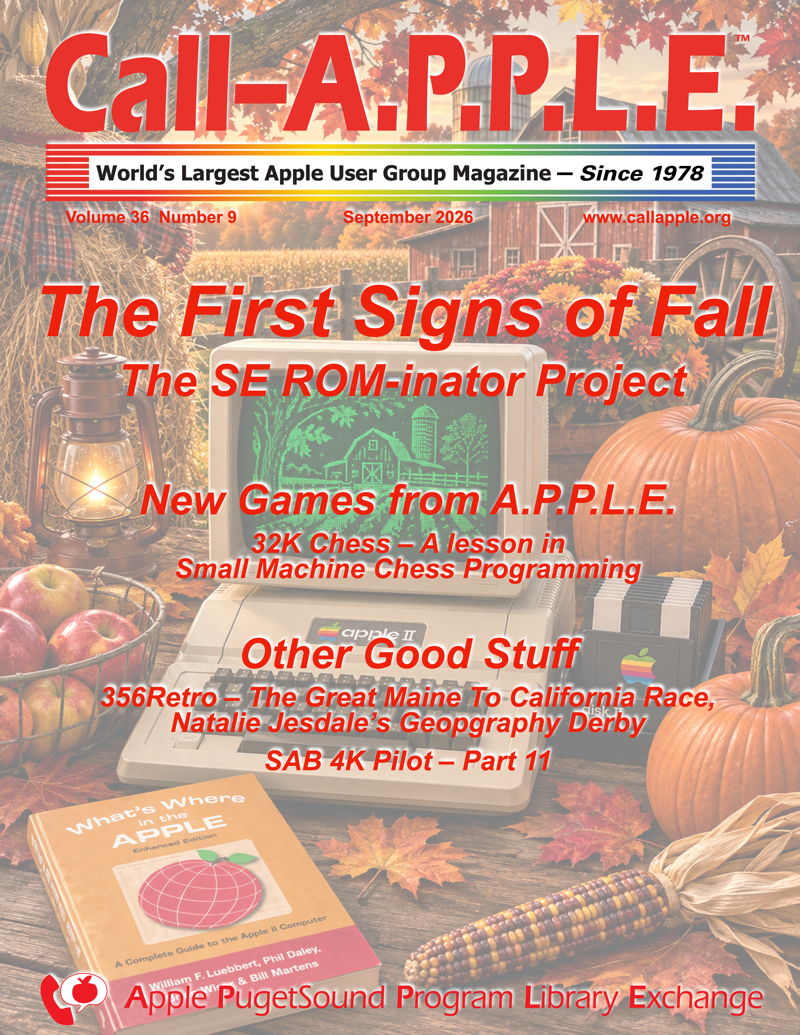
This month, I am writing “The Editor Bytes Back” while Val Golding takes a short hiatus. In trying to figure out what to write, it occurred to me that no one ever talks about the early software companies that rose up out of the Apple II world. With this revelation, I figured I’d attempt it, having been one of those teenage programmers that the Apple II world so readily reflected in the 1980s.
The day the music died
Like all good things, the companies many of us came to know struggled in the mid-‘80s downturn and vanished from the public eye. Applied Engineering, Beagle Brothers, Nibble, and yes, even A.P.P.L.E. disappeared for a time. While many of the people associated with those companies have either long since retired or gone on to other things, there are still a select few who work with Apple computers, teach others how to use them, and are active members in either Apple or Macintosh user groups.
The Birth of an Industry
During the early 1980’s, there were many wonderful products for the Apple II series computers. Many of these products were more home grown than mainstream jobs. Software companies appeared overnight with the hottest software on the planet and then in many cases died just as quickly. This was the phenomenon of the teenage programmer of the day. Write a program which would entrance your fellow Apple II users, put it on a floppy, advertise it through Call -A.P.P.L.E. and other magazines and next thing you knew, you had a global hit.
Beagle Brothers and AE went out of business with the discontinuance of Apple II production. Others such as Origin Systems, Print Master, and a few other companies continue to hawk their wares today. Many of them are still doing well. However, the common theme throughout the companies that remain: they no longer support Apple II products.
Apple for a long time took the same approach in their support concept. Make a product, and then a year later, discontinue supporting it. This happened many times for the Apple II/II+, IIe, IIc and finally even the IIgs. But in the end, the IIe was the one machine that spanned more than a decade of usage. Yet, Apple’s support, never great at its best, was almost non-existent by the end.
Many companies made their reputations on the success of a single product or program. There were companies like Origin Systems’ Akalabeth followed by Ultima I as well as basement startups like Programma International, Electronic Arts, Synergistic Software, Springboard, and most loved of all, Beagle Brothers.
Other companies also followed Apple’s example in their support policies. While this is in many cases a thing of financial decision-making and not logic, support by the companies could have extended the life span, allowing the machines to even be used in the main stream today. While support and even software availability have waned to almost nothing, a few schools today may still have an Apple II somewhere in the schools and homes of collectors. For most people though, The Apple II is most likely, to be collecting dust in a warehouse or the dark corner of a storage room instead of actually be used.
In many cases, the owners ages averaged 15-20 and knew more about computers than most of their adult contemporaries. By the time many of these hot shot programmers reached drinking age in most states, they had already made millions in the software industry.
Company leaders and the primary programmers were more often known by their nickname or handle, more than their real name. In business and computing magazines, people learned the real names of these heroes of the software world but even to this day, people still remember the nicknames before they can think of the real names.
The next 20 years
There are but a handful of us proud Apple II owners remaining, but to us, it is still the one machine that to this day remains unparalleled in its ease of use, openness, and ability to make creators and programmers of the general public.
Most of these young programmers wisely took their money, got out and retired. A few continued to work with their companies even after hitting the big time. While it was nothing like the fanatical IPO-crazy world of the recent Internet boom days, it was still a trail-blazing lunacy which made the software and computer industry what it is today.
It is amazing that so much of the software and even the hardware can still be found today in mostly fair to good condition. One reason for this is that the people who owned Apple IIs treated them like their own baby.
Another reason for the longevity of the Apple II series computers is the production processes were both less complicated and better. The machines were built for the long haul and, although some machines had problems, for the most part, they were easy maintenance.
When was the last time you saw an 8088 machine or even a 386 machine that was still looking as good and working as well as an Apple II. Try again in about 20 years. See if you can even find what we today know now as a PC. I can almost guarantee you will be able to find more Apple II’s than probably even 586’s.
In closing, we would like to say to those who are thinking about selling their Apple II computer because it is taking space, think about it before you do. The machine is not only the best educational machine there is, but also the most accessible for those who wish to experiment electronically.