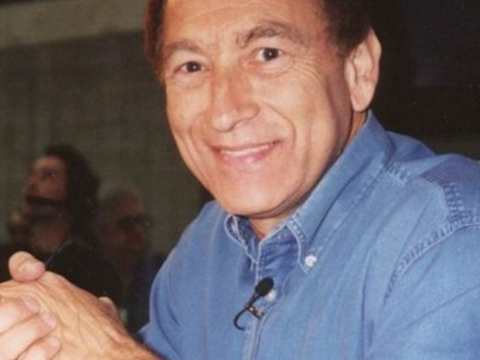
Dale Eugene LaFrenz (September 21, 1937 – February 25, 2026) was a visionary mathematics educator, early adopter of computers in the classroom, and the driving force behind the Minnesota Educational Computing Consortium (MECC). As a teacher-turned-executive, he transformed MECC from a state-funded consortium into a powerhouse that delivered computer access to nearly every Minnesota schoolchild and popularized landmark educational software like The Oregon Trail. His leadership helped launch the educational technology industry in the United States, bridging mainframe time-sharing in the 1960s–70s to the microcomputer revolution of the 1980s. Even after MECC’s corporate evolution and eventual sale, LaFrenz remained active in ed-tech innovation through his later work with RE@L Inc.
Born in Cresco, Iowa, LaFrenz grew up in St. Charles, Minnesota, graduating from St. Charles High School. He served in the U.S. Army before pursuing higher education. He earned a bachelor’s degree in mathematics education from Mankato State University in 1959. He later completed advanced studies at the University of Minnesota, including a master’s degree in mathematics education (supported by a National Science Foundation fellowship at Marquette University) and, according to family records, a PhD in Mathematics.
LaFrenz began his teaching career in mathematics at Faribault Junior High School, where he met fellow teacher Jodeen. The couple married in 1963 and raised four children—Jason (Naomi), Jennifer, Sarah (Jason Bass), and Todd (Jackie)—while living in St. Anthony, Arlington Heights, Illinois, and finally Eden Prairie, Minnesota. Family life centered on road trips, sports, music events, and weekends at the cabin. Jodeen, his wife of 57 years, predeceased him. He is survived by his children, seven grandchildren (Ian, Emma, Will, Gavin, Maddy, Matea, and Sam), brother Dean (Carol) LaFrenz, extended family, and companion Sharon Knapp.
In the early 1960s, while teaching at the University of Minnesota’s laboratory school (University High School, or U-Hi, in Peik Hall), LaFrenz became part of a pioneering group of five mathematics educators—including David C. Johnson, Pam Katzman, John Walther, Tom Kieren, and Larry Hatfield—who recognized computers’ potential to transform learning. During the Sputnik era, when science and math education were national priorities, they experimented with early computing tools. Initially using punched cards mailed to Control Data Corporation, they quickly adopted time-sharing systems. In 1963–1964, funded by a $5,000 GE Foundation grant, they connected a Model 33 teletypewriter via acoustic coupler to Dartmouth’s GE computer running the BASIC programming language—one of the earliest classroom uses of remote computing in the U.S.
The group emphasized problem-solving over drill-and-practice. Students wrote programs (algorithms) to explore mathematical concepts. They developed the CAMP (Computer Assisted Mathematics Programming) series of textbooks for grades 7–12, published by Scott Foresman between 1965 and 1967. LaFrenz and colleagues evangelized these methods through the Minnesota Council of Teachers of Mathematics, leading to widespread BASIC programming instruction in Twin Cities schools by the late 1960s.
In 1968, LaFrenz joined TIES (Total Information for Educational Systems), a federally funded consortium serving over 20 suburban school districts. As director of instructional services, he oversaw time-sharing services on a Hewlett-Packard 2000A system, developed courseware, and trained teachers. TIES demonstrated the feasibility of statewide computer access and influenced similar projects across Minnesota.
Brief stints followed at Honeywell (establishing the EDINET instructional time-sharing network nationally) and consulting roles. By 1973, Minnesota’s educational leaders formed MECC as a joint-powers authority involving the University of Minnesota, state university system, community colleges, and Department of Education. LaFrenz consulted during its planning and joined as assistant director under the first executive director, Don Henderson. MECC centralized computing services, initially via a massive Univac 1110 time-sharing system (later replaced by reliable Control Data Cyber 73 machines). By 1977, MECC provided computer access to more than 95% of Minnesota’s schoolchildren—far ahead of any other state or country.
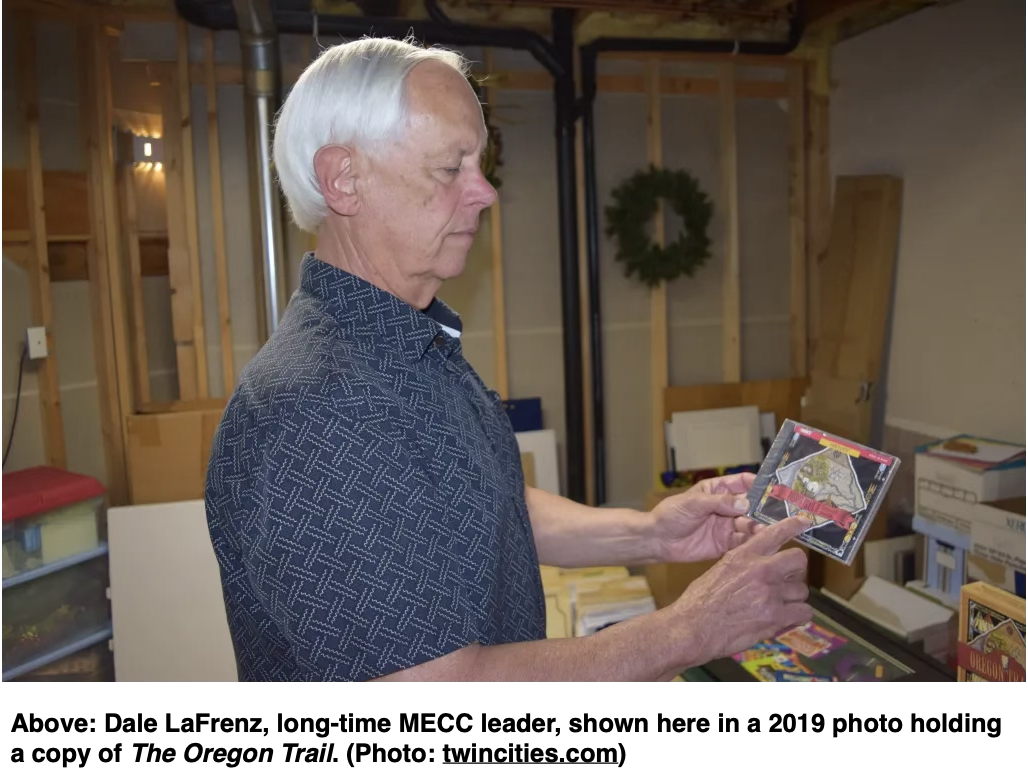
MECC’s software library grew rapidly, including simulations and problem-solving tools. LaFrenz recognized the potential of a 1971 student-created game called The Oregon Trail, originally written by history teacher Don Rawitsch and two colleagues for Minneapolis schools. MECC hired Rawitsch, converted the game for its systems, and distributed it widely. When the Apple II microcomputer emerged in 1977, MECC became Apple’s largest educational reseller in the U.S., purchasing and reselling thousands of units statewide. The company converted its entire time-sharing library to Apple II BASIC and pioneered site-licensing: schools could buy a disk and copy programs freely. The Oregon Trail became a cultural phenomenon, accounting for roughly one-third of MECC’s revenue at its peak and introducing millions of students to history, decision-making, and computing.
LaFrenz briefly left MECC in 1978 to lead electronic publishing efforts at Scott Foresman & Co. in Illinois, where he built a 125-person division. He had a short stint at Mindscape and returned to Minnesota in 1983 for a brief role at Control Data Corporation marketing PLATO/WICAT systems. In 1984 he rejoined MECC as vice president of marketing, later rising to president and CEO. Under his leadership, MECC transitioned in 1983 from a consortium to a taxable, profit-making public corporation (still state-owned). It expanded nationally, sold to a venture capital firm in 1991, went public in 1994, and was acquired by SoftKey (later The Learning Company) in 1995 for $370 million. MECC produced hundreds of titles, including Number Munchers, Math Blaster successors, and sequels like The Oregon Trail II.
After MECC, LaFrenz continued championing educational technology. He served as chairman of the board at RE@L Inc. (Real Experiences at Life), focusing on interactive STEM and health-education games, including programs addressing vaping and smoking prevention. He remained optimistic about ed-tech’s future, drawing on decades of experience navigating school procurement, regional service agencies, and teacher buy-in. Colleagues described him as encouraging creativity, optimistic, and always urging others to “go for it.”

LaFrenz donated extensive MECC archives—including newsletters, photographs, product materials, and oral histories—to institutions like the Brian Sutton-Smith Library and Archives of Play at The Strong museum and the University of Minnesota’s Charles Babbage Institute. His 1995 oral history interview remains a primary source on the birth of educational computing.
A Celebration of Life will be held on April 11, 2026, at 9:30 a.m. at Prairie Lutheran Church in Eden Prairie, Minnesota, with the service streamed online. Condolences could be sent to the family via Charis at 11000 Blossom Road, Eden Prairie, MN 55347.
Dale LaFrenz’s life exemplified curiosity, collaboration, and forward-thinking education. From teletypewriters in a university lab school to millions of students guiding virtual wagon trains across the Oregon Trail, his work shaped how generations learned with technology. As one of the true pioneers of educational software, he helped ensure that computing became not just a tool for schools—but a pathway to discovery for students nationwide. His legacy endures in classrooms, museums, and the ongoing evolution of ed-tech.