Category: Manuals

Seattle, Washington — July 23, 2022 — Apple Pugetsound Program Library Exchange (A.P.P.L.E.) has published an 80+ page manual for “Ringoban 2” – a new game written by Mike Beaumont. Ringoban 2 is an Applesoft BASIC version of the game Sokoban for the Apple II. This updated version by Mike Beaumont expands past the original 90 levels – for a total of 931 levels of brain-warping fun. Plus, version 2 now lets you save your game! Work through the levels…
Seattle, Washington — July 28, 2024 — Apple Pugetsound Program Library Exchange (A.P.P.L.E.) has published “E-Z Pilot” – an updated 90 page manual for the easy-to-use version of the Pilot programming language, created by Earl L. Keyser for the Apple II in 1983 and previously published by A.P.P.L.E. It is especially useful for school teachers and parents. You will enjoy interactive computer sessions. Features Include: Availability E-Z Pilot is available in Paperback – printed in color – through the A.P.P.L.E. bookstore…
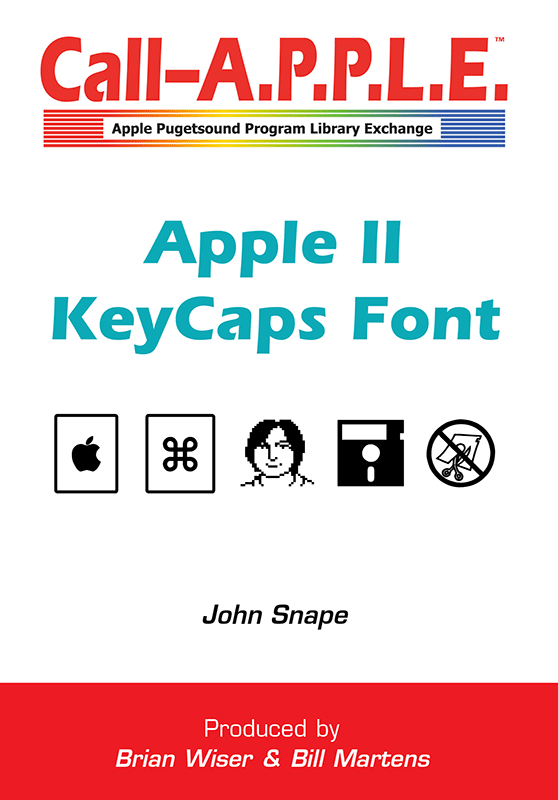
Seattle, Washington — June 20, 2023 — The Apple II KeyCaps OpenType font created by John Snape has been released. The font allows you to make key presses clear in your text, and also includes over 160 glyphs and ornaments for Apple II and Mac documents, such as the Open-Apple and Solid-Apple keys. The printed manual includes instructions and samples of all the fun and useful icons. Availability Apple II KeyCaps Font is available through the A.P.P.L.E. bookstore with production and…

Seattle, Washington — July 23, 2022 — Apple Pugetsound Program Library Exchange (A.P.P.L.E.) has published a new manual for “Double High” written by Robert C. Clardy and Alan B. Clark for the Apple II computer. Generate text in different typefaces, sizes, colors, and angles from your Apple II programs on the Double Hi-Resolution screen. Originally published by Synergistic Software in 1987, it features an easy-to-use editor for creation of your own unique character sets, with 46 fonts included. Assumes a…

Seattle, Washington — July 23, 2022 — Apple Pugetsound Program Library Exchange (A.P.P.L.E.) has published a new manual for “Directory Title Writer” written by Val J. Golding in 1981 for the Apple II computer. Directory Title Writer is a DOS 3.3 utility that lets you create elaborate and fancy file names on your Apple II disk catalog. Type inverse, flash, and lower case directly from the keyboard. Availability Directory Title Writer is available through the A.P.P.L.E. bookstore with production and…

Seattle, Washington — July 23, 2021 — Apple Pugetsound Program Library Exchange (A.P.P.L.E.) has released a new manual for “Applesoft Program Editor” by Richard Hackl. Applesoft Program Editor (APE) is a popular Applesoft BASIC editor for DOS 3.3 and ProDOS that helps you enter lines and correct mistakes. It works in Applesoft, in the Monitor, and can even be used within the programs you write. Availability The “Applesoft Program Editor (APE)” manual is available through the A.P.P.L.E. bookstore with production…

Seattle, Washington — July 8, 2019 — Apple Pugetsound Program Library Exchange (A.P.P.L.E.) has released a newly designed manual for “Signature GS” by Duilio Proni. Signature GS is a collection of Control Panels (CDEVs) that make your Apple IIGS easier and more fun to use by adding a Screen Blanker, a Desktop Pattern Editor, a Sound Selector, and a Boot Setup Utility to GS/OS version 5.0 or later. Originally published by Quality Computers, Inc. in 1992, this redesigned edition was…

Seattle, Washington — July 8, 2019 — Apple Pugetsound Program Library Exchange (A.P.P.L.E.) has released a newly designed manual for “Six Pack: A Refreshing Collection of Utilities for Apple IIGS System 6” by Bill Tudor. Six Pack, the first collection of Apple IIGS Finder Extensions, adds 13 new features to System 6. Just click the icons you want to work with, then select the Six Pack functions you want to perform from the Extras menu. Originally published by Quality Computers,…

Seattle, Washington — July 5, 2019 — Apple Pugetsound Program Library Exchange (A.P.P.L.E.) and Bill Martens are proud to announce the immediate availability his programming manual “Appilot/W1.” Appilot/W1 is a complete and interactive Pilot Programming Environment for the Apple II. Appilot/W1 allows users to create and execute full-fledged Pilot programs in a single lightweight environment without sacrificing time or effort. Comes complete with built-in DOS, editor, and interpreter. Availability The “Appilot/W1” manual is available through the A.P.P.L.E. bookstore with production…

Seattle, Washington — July 5, 2019 — Apple Pugetsound Program Library Exchange (A.P.P.L.E.) is proud to announce the immediate availability of “DOS Disk Analyzer” by Ronald A. Thisted. DOS Disk Analyzer views and prints the raw contents of an Apple II DOS 3.3 disk. It features a specially-formatted printout of the VTOC, Catalog, and Track/Sector list. Once this information is read from the disk, sectors can be viewed for any file. Availability The “DOS Disk Analyzer” manual is available through…

Seattle, Washington — July 5, 2019 — Apple Pugetsound Program Library Exchange (A.P.P.L.E.) has released the manual for “Applesoft Carpenter II.” Applesoft Carpenter II is a collection of seven utility programs for Applesoft programmers that enhance programming productivity. The tools were written for the Apple II by three well-known programmers: Wayne Eastwood, Glen Bredon, and Val J. Golding. Availability The “Applesoft Carpenter II” manual is available through the A.P.P.L.E. bookstore with production and fulfillment by Lulu.com. A disk image will…

Seattle, Washington — July 5, 2019 — Apple Pugetsound Program Library Exchange (A.P.P.L.E.) and Ken Nozaki are proud to announce the immediate availability of his “Apple Tic-Tac-Toe” game. Apple Tic-Tac-Toe is an age-old game which is great fun for kids of all ages – and programmed by a kid! This version is a completely designed and programmed version of the game intended to make the computer one of the toughest opponents possible. Availability The “Apple Tic-Tac-Toe” manual is available through…


The WOZ format, the mainstay of the Applesauce project by John Morris, has been officially released. This new format for reading and writing Apple II floppy disks allows emulators to more accurately reflect the actual data on an Apple II floppy disk and disk image. Version 1.0 of the format document is now available for download to developers via John’s website at: http://evolutioninteractive.com/applesauce/woz_reference.pdf

John Morris, creator of the Applesauce project, has released a preliminary version of the document outlining the new WOZ format for Apple II disk imaging. The format which was created specifically for the Applesauce project, allows emulators to more read the disk images which are produced by Applesauce as well as to write disks in a manner that is more accurate. Applesauce, which was highlighted in Call-A.P.P.L.E. Magazine V.27 N 02 , is a hardware solution which reads and writes…

The Apple II Scane website has added a slew of new items including the manual for Apple-Cillin II, another issue of The Apple Education Newsletter, and “A Personal Guide to Computers”. The documents are freely downloadable from the site and can be reached at: http://www.apple2scans.net

The documentation / manual for the Apple II game, Beyond Castle Wolfenstein, is now available from the Apple II Scans website. The 10mb download offers a high definition look into the Silas Warner produced game and is a free download. For more information or to download the manual, check out the Apple II Scans website at: http://www.apple2scans.net/2017/01/04/beyond-castle-wolfenstein-muse-software-1981/ Those users who wish to try the game out, you can find it on the Virtual Apple II website at: http://www.virtualapple.org/beyondcastlewolfensteindisk.html


David Finnigan, author of the widely acclaimed New Apple II Users Guide, announced a price reduction of the book for the holiday season. According to the press release posted in the CSA2 newsgroup, “Just in time for the holidays! The price of the hottest new book for the Apple II series, The New Apple II User’s Guide is now reduced from $25 to the low, low price of a mere $20! Don’t miss your chance to snatch up your first…

Oliver Schmidt, long known for his work on several projects in the Apple][ community including Contiki and Applewin, has now delved into documenting the internals of GEOS, the Berkeley Softworks produced operating system for the Apple ][. In his announcement in the comp.sys.apple2 newsgroup, Oliver says” Although the Apple GEOS filesystem is based on ProDOS 8 the Apple GEOS files are not standard ProDOS 8 files. I’m not refering to file content here but to the file structure – meaning…
The entire collection of the French version of the Apple ][ Developers, a documentation package for Apple developers is now available online. The entire package is from about 1985 and has been made available in digital format on the Brutal Deluxe website. Here is the table of contents: Sommaire (PDF, 25 KB) Les outils souris texte de l’Apple II (Apple II mousetext tools) (PDF, 4.1 MB) Les règles de l’interface souris (mouse interface rules) (PDF, 5.7MB) Utilitaires de programmation (programming…

As is one can tell from the dates on my posts, I spent a while tracking this one down. The original link is in a now inaccessible e-mail account so I went out and located it directly on the web. The date of the manual is in 2010 so it looks as though it is being kept relatively up to date. For those interested in why I am posting this particular link, the reason is simple. BASH is the shell…